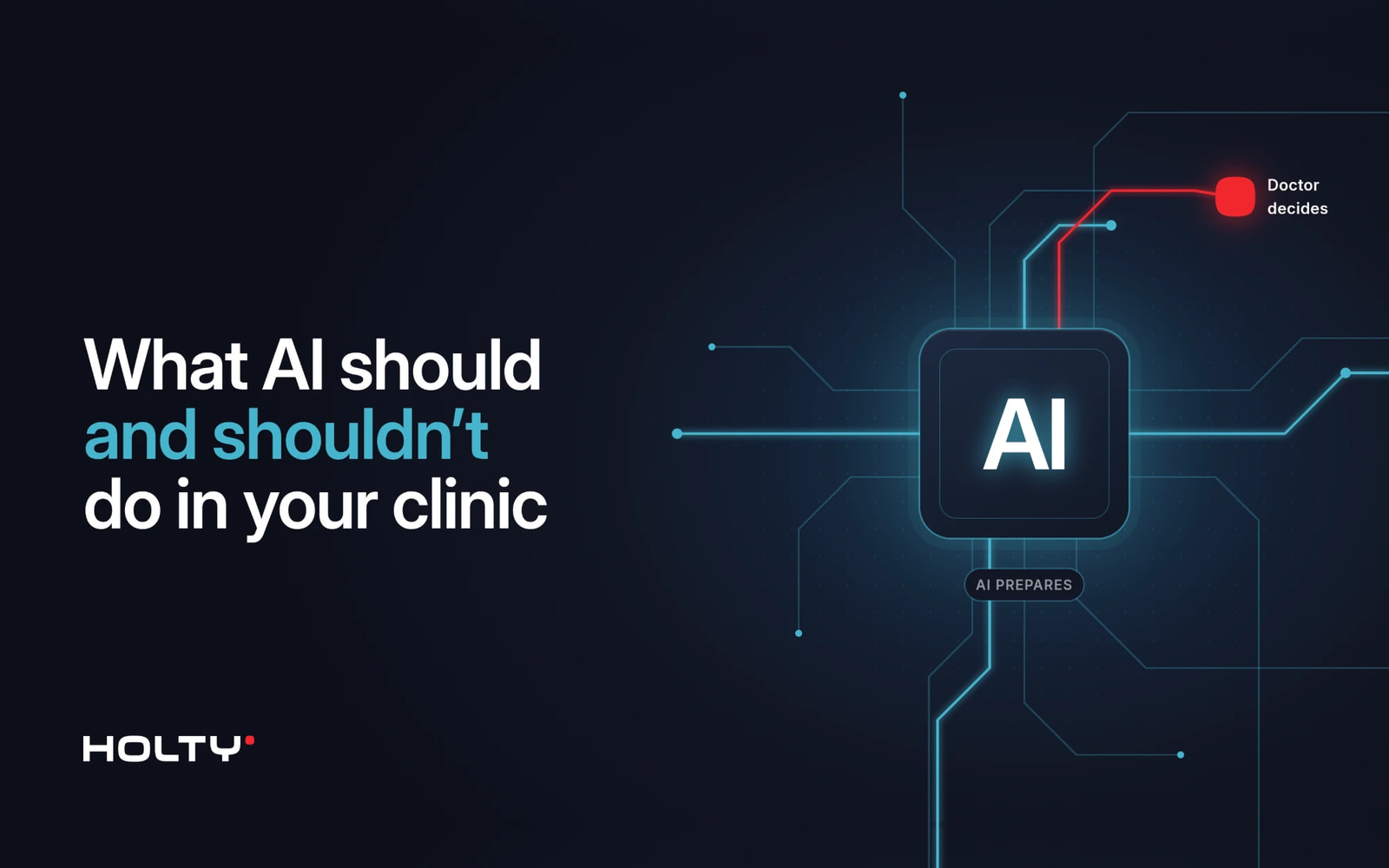
AI should prepare, sort, summarise and spot patterns, so that doctors and staff have more time for patients. It should not diagnose, prescribe, make a clinical decision or pretend to be a person. A simple rule covers most cases: AI prepares, the doctor decides. Any tool a clinic buys should also say where patient data goes and let staff check and correct what the AI did.
Almost every clinic software product now says it has AI. For a director, the useful question is not what AI can do. It is what AI should do in your clinic, and where a person must stay in charge. This guide sets out a clear line, a short test for any AI feature and the questions to ask a vendor.
One rule: AI prepares, the doctor decides
Medicine rests on responsibility. A doctor answers for a diagnosis and a treatment, and a patient trusts that person. AI can make that work easier by doing the preparation, but it cannot carry the responsibility. So the line is simple. When AI gathers, sorts, drafts or points something out, it helps. When it decides about a patient's health, it has gone too far.
The World Health Organization's guidance on the ethics and governance of AI for health starts from the same place: AI should not take away human autonomy, and people stay accountable for decisions that affect patients.
What AI should do in your clinic
- Collect information before the visit. A patient describes the problem in the app, the AI asks follow-up questions and puts the answers into a structured form. The doctor reads it before the consultation and starts from the patient, not from a blank page.
- Route patients to the right place. Suggesting a specialty, or a service that fits the question, saves the patient from booking the wrong doctor and starting again.
- Draft, for a person to check. Visit notes, summaries and messages can be drafted by AI. A doctor or a member of staff reviews them before they are used.
- Take over repeated questions. Opening hours, preparation steps, where to go and which slots are free are questions with a clear answer. A bot can give them at any hour and hand over to a person when the question is not routine.
- Spot patterns that nobody has time to see. Which questions patients ask most often, which calls end without an answer, which patients are overdue for a check-up. A person can act on a pattern; a person cannot listen to every call.
- Send the right message to the right patient. Describing a group in plain language, such as "patients overdue for an annual check-up", and reminding them in time is care, not noise.
What AI should not do
- Diagnose. A list of possible causes in a chat window is not a diagnosis, and a patient may treat it as one. Diagnosis belongs to a doctor who can examine the patient.
- Prescribe or recommend treatment. Any treatment advice must come from a licensed doctor who knows the patient's history.
- Decide without a person. A decision about a patient's care, access or priority should never be left to AI alone.
- Pretend to be a human. A patient should know when they are talking to an AI and be able to reach a person.
- Invent an answer. AI can sound sure and be wrong. A price, a preparation instruction or a date must come from the clinic's own data, not from a guess.
- Send patient data where the clinic cannot see it. A clinic should know where data is processed, who can reach it and what is kept.
- Replace the human moment. A frightened patient, a bad result and a complaint need a person.
A five-question test for any AI feature
Before a clinic buys or switches on an AI feature, five questions help:
- Who decides? If the answer is "the AI", stop.
- Where does the data go? Is it processed inside the clinic, in a cloud, or by a third party? Is any of it kept or used to train a model?
- Can staff see why? A summary, a score or a finding should come with the source, for example the exact words in a call, so that a person can check it.
- Does the patient know? The patient should be told when AI is involved and have a way to reach a person.
- What happens when it is wrong? Someone should be able to correct it, and the correction should be easy.
Where the evidence stands
The research is encouraging and not yet complete. A systematic review of 211 studies on AI-based triage (Applied Nursing Research, 2025) found real potential for more accurate, efficient and consistent triage, and also found that the evidence is still developing. In a study in JAMA Network Open, 263 physicians were surveyed before and 30 days after starting an ambient AI scribe, and the share reporting burnout fell from 51.9% to 38.8%. That study had no control group, covered one vendor and ran for 30 days, so it shows promise rather than proof.
The sensible reading is this: AI helps most with preparation and paperwork, and the evidence is strongest where a person stays in the loop. A clinic should measure its own results before and after, and not rely on a vendor's figures.
Questions to ask any AI vendor
- Does the AI ever diagnose, prescribe or decide? If yes, how is that controlled?
- Where is patient data processed, and can it stay inside the clinic's own network or country?
- Is any patient data used to train the vendor's models?
- Can a member of staff check every output against its source?
- What happens when the AI is unsure, and how does a patient reach a person?
- What does the vendor say about its limits, and can it show them in writing?
Rules for medical AI differ by country and are changing, so a clinic should check the local requirements with its legal advisor before it switches on a feature that touches patient data.
How Holty can help
Holty applies this line in its own tools. AI Intake: the AI collects symptoms and structured information from the patient before the visit, the doctor sees it in advance and makes every clinical decision. The AI does not diagnose, prescribe or recommend treatment.
Segmentation in the Retention Engine works in plain language: staff describe a group of patients and the system builds it from live data in the clinic's HIS, so each patient gets a message that fits. Call Intelligence transcribes calls, groups patient questions by topic and checks calls against the clinic's own script, with a quote and a timecode behind every finding. It runs inside the clinic's network, with no cloud and no third-party AI. The clinic keeps its data and its decisions.
All of it is part of the Holty platform. Two related guides: Top 5 AI Tools Your Clinic Needs and What Patients Ask Your Call Centre.
See where AI fits in your clinic
Book a 15-minute demo and we will walk through it with your clinic in mind.
Frequently asked questions
Can AI diagnose my patients?
It should not. AI can collect symptoms and prepare a summary, but diagnosis needs a doctor who can examine the patient and knows their history. A tool that presents a diagnosis to patients without a doctor creates risk for the patient and for the clinic.
Do patients need to know they are talking to an AI?
Yes, as good practice. A patient should know when AI is involved and be able to reach a person. Legal requirements differ by country, so check them with your legal advisor.
Will AI replace my doctors or my front desk?
No. It takes over preparation and repetitive questions, so your team has time for the conversations that need a person. Decisions stay with doctors, and sensitive calls stay with staff.
Where does patient data go when we use AI?
That depends on the tool, and it is the first thing to ask. Some tools process data in a vendor's cloud. Others work inside the clinic's own network. Ask where data is processed, who can reach it and whether it is used to train models.
What if the AI gets something wrong?
Plan for it. Staff should be able to see the source of every output, correct it and report it. Anything that affects a patient's health should always be checked by a person.
Does AI work with the system we already have?
It should. An AI tool that needs a second copy of your data creates another place to keep in sync. Look for a layer that connects to your HIS in both directions, so nothing is entered twice.
Where should a clinic start?
Start where a mistake costs little and the gain is clear: preparation before the visit, repeated questions and patterns in calls. Keep clinical decisions with doctors, and measure the result against your own numbers.
Sources
- World Health Organization: Ethics and governance of artificial intelligence for health (2021).
- Applied Nursing Research (2025): systematic review of 211 studies on AI-based triage.
- JAMA Network Open: ambient AI scribe study, 263 physicians, six U.S. health systems. Summary: Yale School of Medicine.
- Holty product pages: the Holty platform and Call Intelligence.