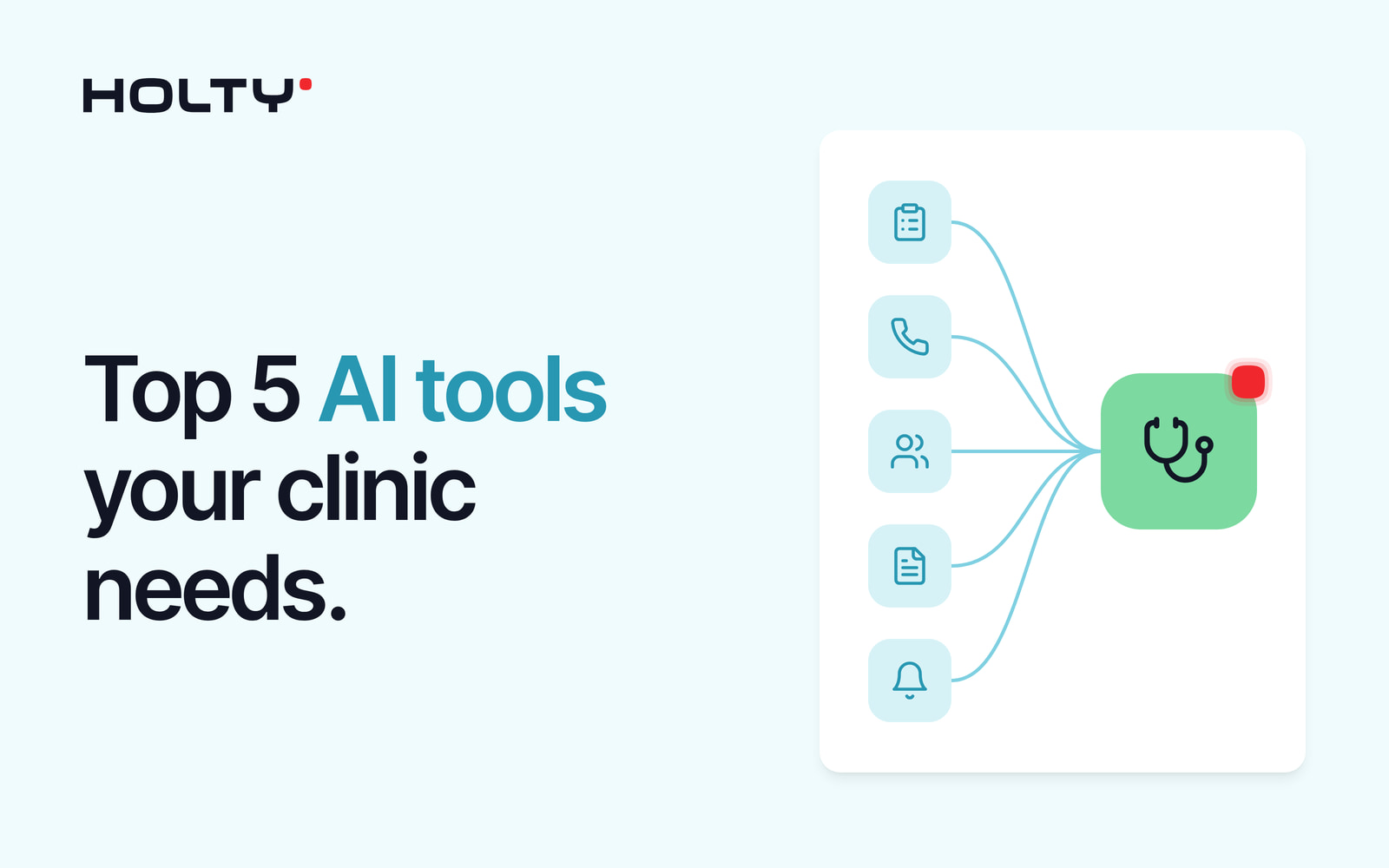
The five AI tools with the clearest value for a clinic are AI intake and triage, AI call-center analytics, AI audience segmentation, ambient AI scribes and smart reminders. Each takes over a repetitive task and leaves the clinical decision with a doctor. The list below shows what each does and where it stops.
- AI intake and triage: collects symptoms, suggests the right specialty and prepares the doctor. Limit: routing, not diagnosis.
- AI call-center analytics: transcribes calls and shows trending questions and gaps. Limit: shows where to improve, does not replace staff.
- AI audience segmentation: builds patient groups from a plain-language description. Limit: must follow GDPR, and the clinic keeps control of its data.
- Ambient AI scribe: drafts the visit note for the doctor to review. Limit: the doctor reviews every note.
- Smart reminders: sends the right reminder, through the right channel, at the right time. Limit: the strongest evidence is for reminders themselves.
Clinics are being offered AI in every product now, and most of it is a label on an old feature. This guide covers the five tools that make a real difference to the people who work in a clinic and the patients who come to it. One rule applies to all five: AI prepares, the doctor decides.
1. AI intake and triage: the right specialist from the first visit
AI intake and triage helps a clinic by sending each patient to the right specialist before the first visit. A patient types what is wrong. The tool asks a few follow-up questions, collects the answers in a structured form and suggests the right specialty. The doctor receives the summary before the visit and makes every clinical decision.
This fixes a quiet problem. Patients often guess at the specialty, book the wrong doctor and start again. A good intake step prevents the wasted visit and gives the doctor a prepared patient.
What the research says: a systematic review of 211 studies (Applied Nursing Research, 2025) found real potential for more accurate, efficient and consistent triage, and also found that the evidence is still developing.
The limit: triage is routing, not diagnosis. A patient should always know when they are talking to an AI system and when a doctor has taken over. Holty can implement this as AI Intake: AI collects, the doctor decides and signs.
2. AI call-center analytics: what patients ask when they call
AI call-center analytics shows a clinic what patients ask when they phone. A clinic cannot listen to every call, so the tool transcribes calls and shows the pattern: which questions are most common this month, which go unanswered, how complete the answers were. Teams use real calls for training.
Phone calls are still how many patients reach a clinic. According to MGMA DataDive, about 23% of calls to medical practices go unanswered. Each of those is a patient who tried to get care.
The limit: the tool shows where service can improve. It does not replace a person who answers kindly. Holty can implement this as AI Call-Center Analytics: it turns calls into a view of what patients need, so the clinic can fix the cause, such as a missing answer in the app or a question the website does not address.
3. AI audience segmentation: the right message to the right patient
AI audience segmentation lets a clinic send each patient a relevant message instead of the same one to everyone. It sends each patient what is relevant: a check-up reminder to someone overdue for one, a program to someone who asked about it.
The newer part is how the audience is built. Instead of filters and spreadsheets, staff describe the group in plain language, for example "patients who have not had an annual check-up", and the tool builds the list from clinic data. Holty can implement this in its Retention Engine, where the list feeds push, SMS, email and in-app messages.
The limit: data protection. Segmentation has to follow GDPR, and the clinic must keep control of its data. The aim is personal care, not more messages.
4. Ambient AI scribe: less typing, more time with the patient
An ambient AI scribe gives doctors time back by drafting the visit note. It listens to the consultation, with consent, and the doctor reviews the draft. It is the most studied tool on this list.
In a study published in JAMA Network Open, 263 physicians across six health systems were surveyed before and 30 days after starting an ambient scribe. The share reporting burnout fell from 51.9% to 38.8%.
The limit: this was a before-and-after survey without a control group, covered one vendor and ran for 30 days. The results are encouraging, and longer studies are needed. Notes also need a doctor's review before they enter the record.
It belongs on the list because it is one of the clearest ways to give doctors time back. It works alongside the patient-facing tools above, with the clinic's HIS as the shared record.
5. Smart reminders: care that arrives before the appointment
Smart reminders reduce no-shows. A reminder is a small act of care. It helps a patient remember a visit, reschedule early and prepare. A study by Robotham and colleagues (2016) found a no-show rate of 15% with reminders against 21% without.
AI adds timing and relevance: who should get a reminder, through which channel, and when. A patient who prefers Telegram or WhatsApp is reached there, not by a text they ignore. Holty can implement reminders by segment and channel: app push, SMS, email, Telegram and WhatsApp.
The limit: the strongest evidence is for reminders themselves. Smarter targeting is newer and less studied, so a clinic should measure its own no-show rate before and after.
What the five tools have in common
Each tool takes over a task that never needed a person's attention, and each leaves the decision with a person. Each also depends on clean data. A tool that is not connected to the clinic's HIS creates one more place to copy information. That is why two-way HIS sync matters more than any single feature.
How to choose AI tools for a clinic
- Start with the problem you can measure: unanswered calls, no-shows, wrong-specialty bookings or documentation time.
- Pick tools that hand over to a doctor visibly, and say plainly when AI is involved.
- Check where patient data is stored and who controls it. On-premise or EU-cloud deployment keeps it with the clinic.
- Choose a platform that connects to the existing HIS without a migration.
- Measure the result after three months against the number you started with.
How Holty can implement these tools
Holty is a white-label patient engagement platform for private clinics and hospitals, built by CodeVentor. It is the layer on top of a clinic's HIS. It can implement AI Intake, plain-language segmentation and reminders through the Retention Engine, and AI Call-Center Analytics, all inside a branded patient app. 0% commission, no vendor lock-in, and the clinic keeps its data.
See these tools on your own setup
Book a 15-minute demo and we will walk through it with your specialties in mind.
Frequently asked questions
Which AI tool should my clinic start with?
The one that addresses a problem you can already measure. For many clinics that is unanswered calls or no-shows, because the numbers are in the system.
Can AI make clinical decisions for my doctors?
No. Intake and triage tools route patients, and scribes draft notes. A licensed doctor makes and signs every clinical decision.
Will AI replace my staff?
No. These tools take over repetitive work such as transcription, sorting and reminders, so staff have more time for patients.
Is my patients' data safe with AI tools?
It depends on where the data is stored and who controls it, and a clinic should know the answer before it signs. Holty can be deployed on the clinic's own servers or in an EU cloud, and segmentation follows GDPR.
Will this work with the HIS we already use?
Holty connects to the existing HIS through a two-way sync, without migrating data. Bookings made by phone or at the front desk appear in the app, and the other way round.
Do we need our own IT team to run it?
A clinic can run Holty on its own servers, or choose a hosted EU cloud deployment. Both have the same features.
How soon will we see results?
Measure after about three months against the number you started with. A short pilot shows direction. It is not proof.
Sources
- Applied Nursing Research (2025): systematic review of 211 studies on AI-based triage.
- JAMA Network Open: ambient AI scribe study, 263 physicians, six U.S. health systems. Summary: Yale School of Medicine.
- MGMA DataDive: share of unanswered calls in medical practices (about 23%).
- Robotham et al. (2016): no-show rates with and without reminders (15% vs 21%).