Patients start with AI.
Your clinicians take it from there.
A guided survey collects what the patient reports and reads what they attach. It reaches your HIS already structured, and one of your own doctors confirms the summary and decides what happens next.
Nothing new waiting
In their words
“A headache since Monday”
“Nausea, sensitivity to light”
blood-test.pdf
Reported
Headache, since Monday
Collected by the assistant · 2 questions, 1 document
Every question costs a slot
A patient with a question books whatever is free, or calls reception and hopes. Either way the clinician finds out what it was once the visit has started, and a doctor can only see as many patients as there are open slots.
How a question arrives today
- It comes in by phone, or as an appointment with no reason attached.
- Reception decides what it is, without the patient’s record open.
- The clinician finds out what the visit is for once it has started.
- Questions that never became an appointment leave no trace at all.
With the assistant in front
- The patient describes it in their own words and attaches what they have.
- It reaches the clinic structured, on the patient’s record.
- A clinician reads the summary before deciding what happens.
- Some questions need a room, some need a call, some need an answer.
One assessment, three ways forward
The AI runs an initial analysis of what the patient reported and attached. A doctor confirms the summary, then decides which of the three follows, and only one of them is a video call.
Online consultation
A video call with one of your own doctors, never a third-party pool. The patient joins from the app or a desktop browser, the doctor from your HIS.
In person
The clinician wants to see it in the room. The patient is booked into the clinic with everything they already sent attached.
Answered without a visit
The doctor marks what is missing and the assistant collects it from the patient. When it is back, the doctor writes and signs the epicrisis.
The AI gathers, organises and runs an initial analysis. It does not diagnose, prescribe or decide who is seen. Nothing reaches the patient unsigned by a doctor, and patient data never leaves your approved systems. A doctor confirms the summary before anything follows, with the patient’s record open.
Inside an online consultation
The whole route, from the reminders to the call itself.
What the patient gets
Push, email, SMS and in-app, in their own languageIn the call

 Patient
Reason for visit
Blood pressure review, six weeks after a change of doseIn-call chat
Same visit, minus the room
When the assessment leads to a video call, it still has to be the same care. Here is what it keeps and what it drops.
Stays the same
- Your own clinician, not a third-party doctor pool
- The same patient record and history
- Prescriptions and referrals as usual
- The same invoicing and reporting
Changes
- No travel and no waiting room seat
- Shorter slots, so more follow-ups fit the day
- Documents shared before and during the call
- The note and prescription arrive in the app
What the module includes
Everything an in-person visit produces, plus a way in before one is booked.
Video on app and desktop
Encrypted one-to-one video and audio, joined from the app or a desktop browser. The patient turns the camera and microphone on and off and switches between front and rear camera, and the doctor has the same controls.
Join when the visit is due
The join control stays inactive until the visit is due, so nobody sits waiting in an empty call. Reminders go out the day before, again on the day, and once more when joining opens.
Opens from your HIS
The call link is generated straight into your HIS, so the doctor joins from the schedule with no extra login.
Chat and documents
A chat runs alongside the call and carries messages and files in both directions. Documents can be shared before the visit and during it.
AI assistant
Patients describe symptoms and share documents in chat. What they report arrives with the clinic as a structured request, ready for a clinician to act on.
Notes, prescriptions and the notification
After the call the doctor prepares the note, the diagnosis and the prescription. The patient is notified the moment they are ready, and they sit with the visit in the record.
more patients seen, without adding staff or operating hours.
Book a DemoEstimate based on telemedicine market-growth research, not a guarantee for any specific clinic. Source: Market Data Forecast, 2026.
Same platform, same rules
Telemedicine is a module of your Holty deployment. Every consultation is with your own clinicians, never a third-party doctor pool.
Not sure how video visits fit your current setup? Talk to us about deployment
Questions clinics ask
The ones that come up on every first call.
Does the doctor need another login?
No. The consultation link is generated into your HIS and opens without a separate account.
When can the patient join?
Shortly before the visit, from the app or a desktop browser. Until then the join control is inactive, and reminders go out the day before and again on the day.
What if the patient does not turn up?
They are prompted to rebook, the same as a missed visit in the building.
Can documents be shared?
Yes, before the call and during it, through the in-call chat.
Where do the notes end up?
The doctor prepares the note, the diagnosis and the prescription after the call. The patient is notified when they are ready, and they sit with the visit in the record.
Are these our own doctors?
Always. Patients only ever speak to your clinicians, never a third-party pool.
See a video visit end to end
In a 15-minute call we run a video visit from both sides, patient app and your HIS, on a demo deployment. No slides, no commitment.
Book a Demoor email us at info@getholty.com
Find out what AI thinks about Holty:
Latest from our blog
How to choose a PRM, how much a clinic loses to no-shows and lapsed patients, and more - in our series of articles.
Top 5 AI Tools Your Clinic Needs
Five AI tools that take repetitive work off a clinic team and leave every clinical decision with a doctor. What each one does, what the research says, and where it stops.
How to Choose a PRM for Your Clinic: What a Good System Should Do
A good PRM passes seven tests. Fail the first two - two-way HIS sync and data ownership - and the rest rarely matters. Here is a checklist you can use with any vendor.
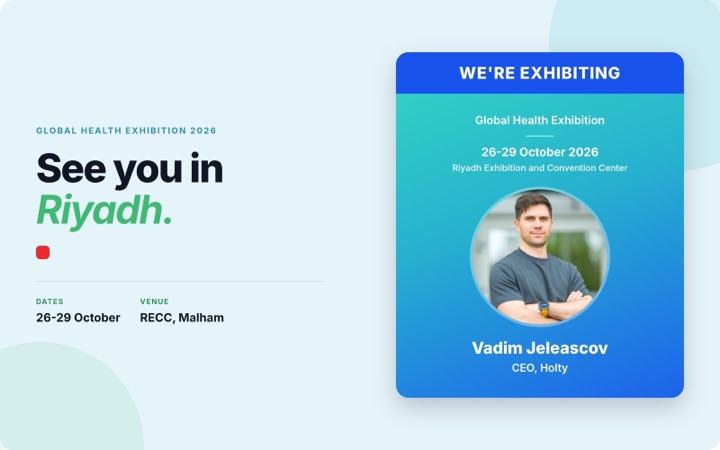
Holty at Global Health Exhibition Riyadh 2026
Our first time at the event. October 26-29 at the Riyadh Exhibition and Convention Center - here is why we are going, and who we want to meet.