A trade fair demo is built to look good. Every stand has a clean screen, a patient app and a dashboard. What separates one vendor from another is what happens after the demo: where the data lives, what your team has to do, and what you are still paying for in year three.
If you are walking the digital health hall this week, these seven questions help you compare vendors on the same basis. Ask them of everyone, including us.
1. What exactly gets installed, and where does it run?
Some products are a cloud service, some run on your servers, some are a mix. The answer decides your hosting, your security review and who is responsible when something breaks.
A clear list of the components, the hosting options you can choose from, and what stays inside your network.
2. If we stop working with you, what do we keep?
Ask about the patient data, the patient relationship and the code. A vendor can be friendly today and still make leaving expensive.
Data export in a standard format, a stated exit process and, where relevant, access to the source code, not just a promise.
3. How does it connect to our HIS, and what happens to the data we already have?
One-way and two-way sync are very different things, and so is a connection that needs a migration first. Ask which of your systems the vendor has already connected to, not which ones it could connect to.
A named integration approach for your HIS, a statement on migration, and a realistic timeline.
4. What does the AI do, and what does it never do?
In healthcare, an AI feature that blurs the line between collecting information and making a clinical decision is a risk for you, not a selling point.
The AI prepares or summarises, and a licensed doctor decides. It does not diagnose, prescribe or recommend treatment.
5. How do we pay, and what changes when we grow?
A licence, a subscription and a commission per booking behave very differently as your volume rises. Ask for the pricing model in writing before you ask for the price.
A model you can calculate yourself for next year and for three years from now, with no charge that grows silently with each booking.
6. What is running in a real hospital today, and what is still in development?
Slides show the roadmap. You want to know which parts are in production, in which hospital, at what size, and which parts are still being built.
A named reference, a clear split between live and planned, and the willingness to say "not yet" about a feature.
7. What will my staff have to do in the first 30 days?
Software that saves time in a demo can cost time in the first month. Front desk, call centre and doctors each carry a different part of the change.
A short rollout plan with who does what, how much of the work is on your side, and what training is included.
How to use this list
Bring one real situation from your clinic, for example the way you handle missed calls or patients who stop coming after a first visit, and ask each vendor to walk through it. A vendor that can show your case is worth more of your time than one that can only show theirs.
Meet us at MEDICA
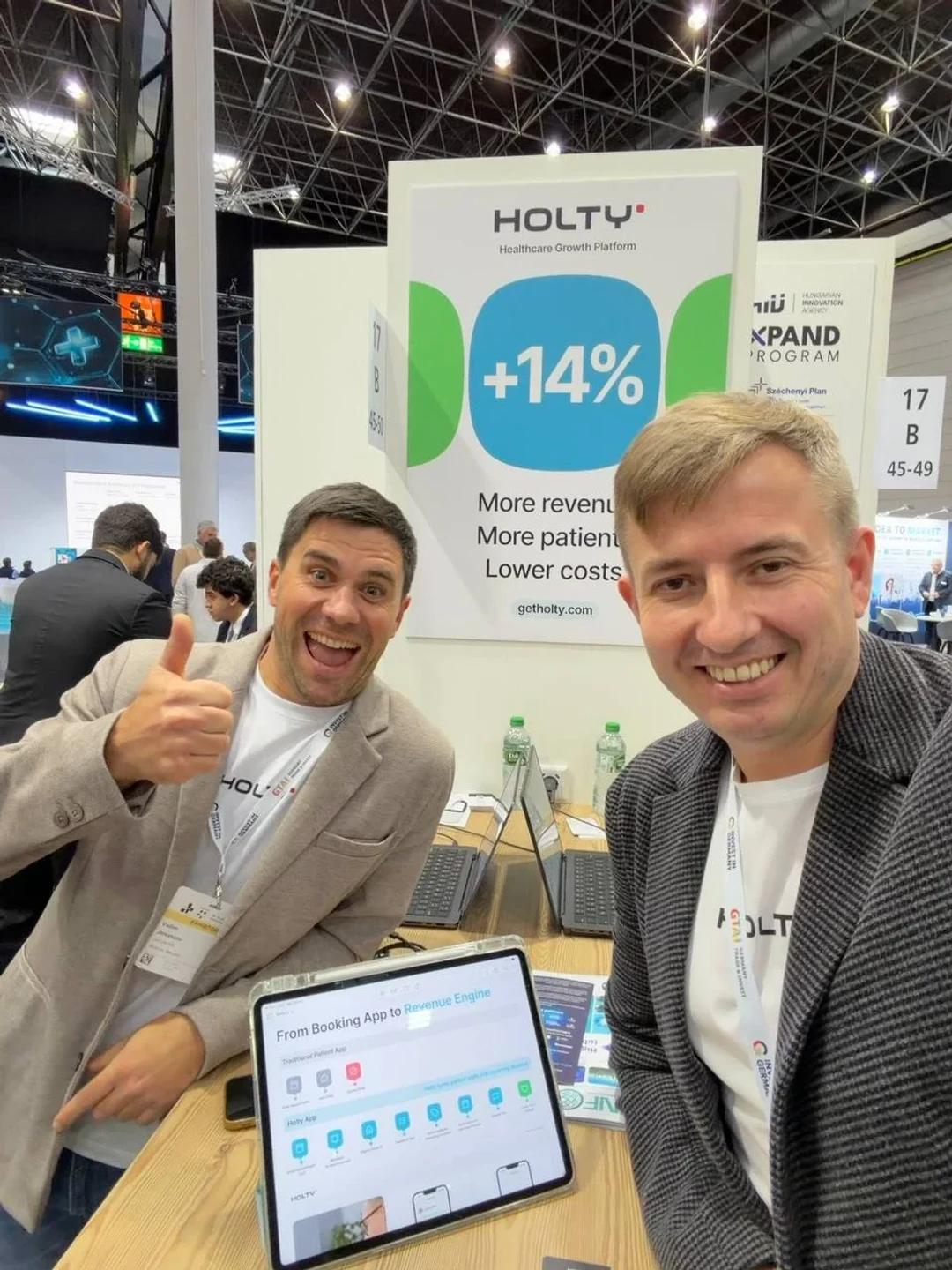
Vadim Jeleascov and Andrei Matcovschi are at MEDICA this week and are happy to answer these seven questions about Holty. Details on where to find us are in our main MEDICA article, Holty at MEDICA 2026 and Slush. If you are still shortlisting, how to choose a PRM for your clinic covers the same ground in more depth.
Not in Düsseldorf?
Book a 15-minute demo and bring the same list.