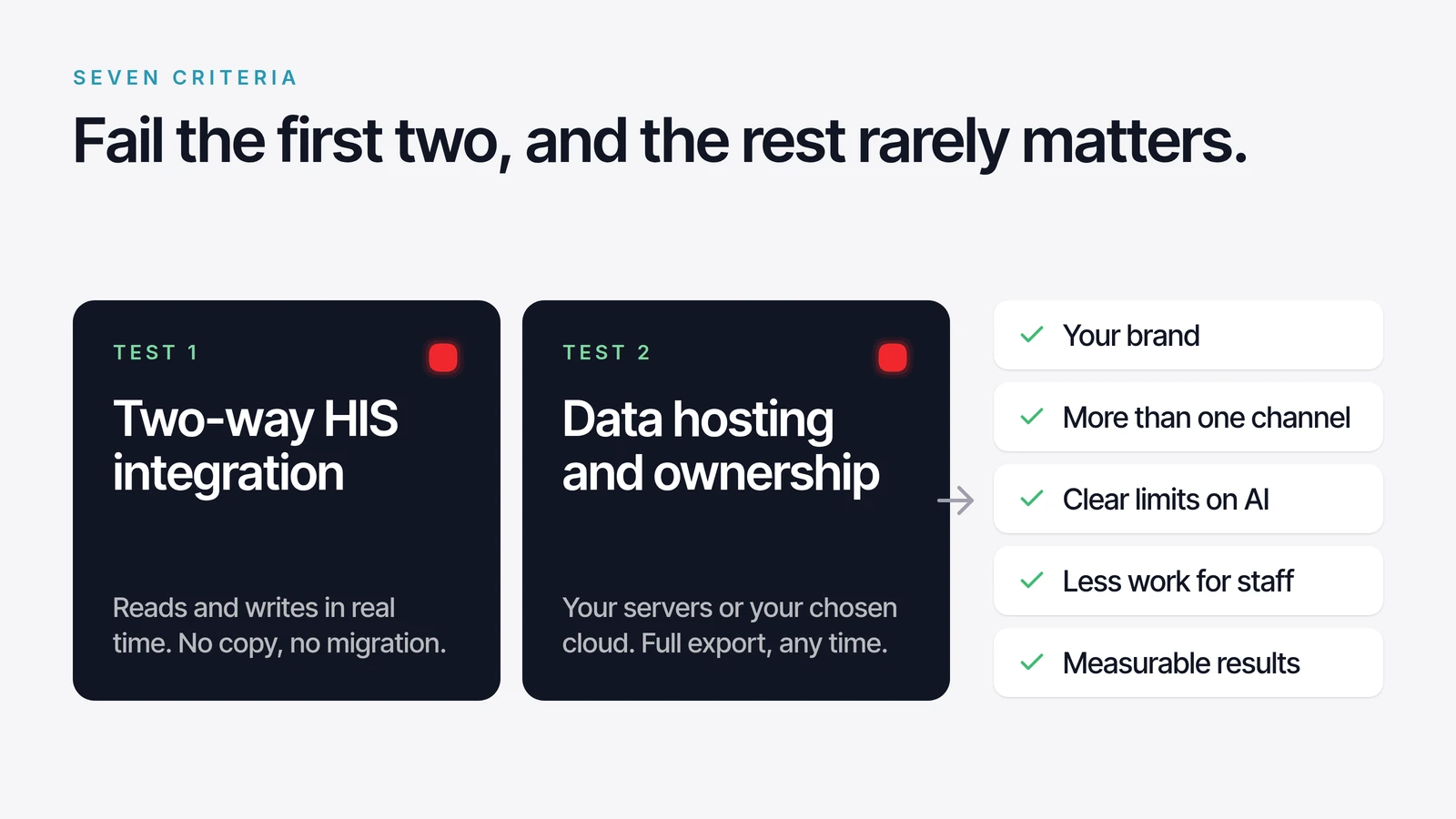
A good PRM passes seven tests: two-way HIS sync, patient data under your control, your brand and your patient relationship, more than one channel, clear limits on AI, less work for your staff, and results you can measure on your own numbers. If a system fails the first two, the rest rarely matters. Below is a checklist you can use with any vendor.
Seven criteria
1. Two-way HIS integration
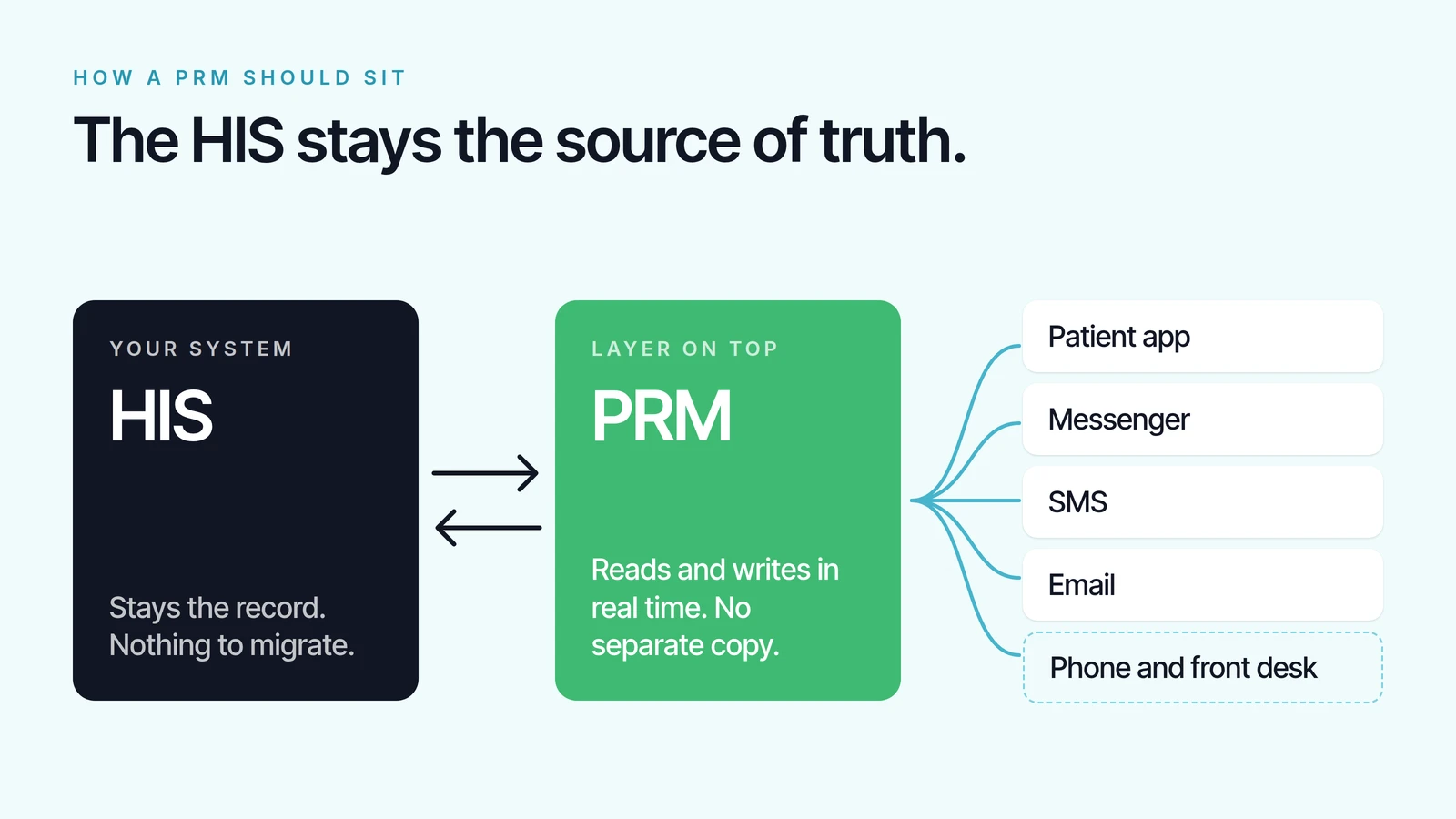
The HIS stays the source of truth. A good PRM reads from and writes to it in real time, keeps no separate copy of the patient, handles HIS downtime without losing bookings, and needs no data migration.
2. Data hosting and ownership
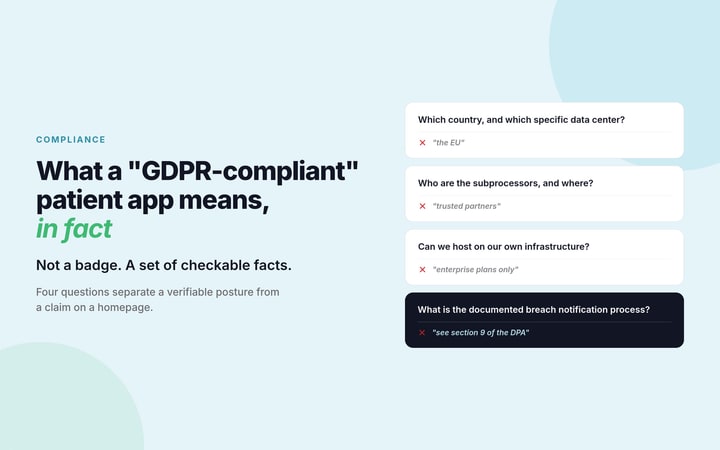
Health data is a special category under GDPR (Article 9), so hosting is part of the product. A good PRM states where data is stored and which subprocessors touch it, can run on the clinic's own servers or a chosen cloud, allows a full export at any time, and returns or deletes the data when the contract ends. Where local rules require in-country hosting, it can be deployed there.
3. Ownership of the patient relationship
The clinic's name is on the app and on every message. Pricing is a licence, not a commission that grows with each booking, and the patient is never shown to competing clinics.
4. More than one channel
Research on patient portals consistently finds lower use among older adults, people with lower income or education, and patients with limited proficiency in the local language. An app alone leaves them out. A good PRM combines app, messenger, SMS and email, and keeps the phone and front desk working.
5. Clear limits on AI
AI collects and organises information before a visit and never suggests a diagnosis or treatment. A clinician reviews and signs off every case, and every step is recorded in an audit trail.
6. Less work for staff
A non-technical person can build an audience and launch a campaign without manual list-building, and messages stop on their own once a patient books. The PRM replaces tasks instead of adding a second system to maintain.
7. Measurable results
It reports visits kept, calls answered and patients reached, with a clear method for attributing each. Expectations stay realistic: a 2016 meta-analysis found that electronic reminders cut missed appointments by about a quarter (15 percent versus 21 percent), and a 2014 meta-analysis found only a small effect of the patient-clinician relationship on outcomes. Meaningful, but modest.
Red flags
- No clear answer on where data is hosted
- Data export only on request, or not at all
- A per-booking commission that rises as you grow
- AI described as diagnosing or triaging without clinician sign-off
- App-only, with no other way to reach patients
- Results claimed without a method, or without a reference you can speak to
- Messaging with no consent controls or frequency limits
What to prioritise by clinic type
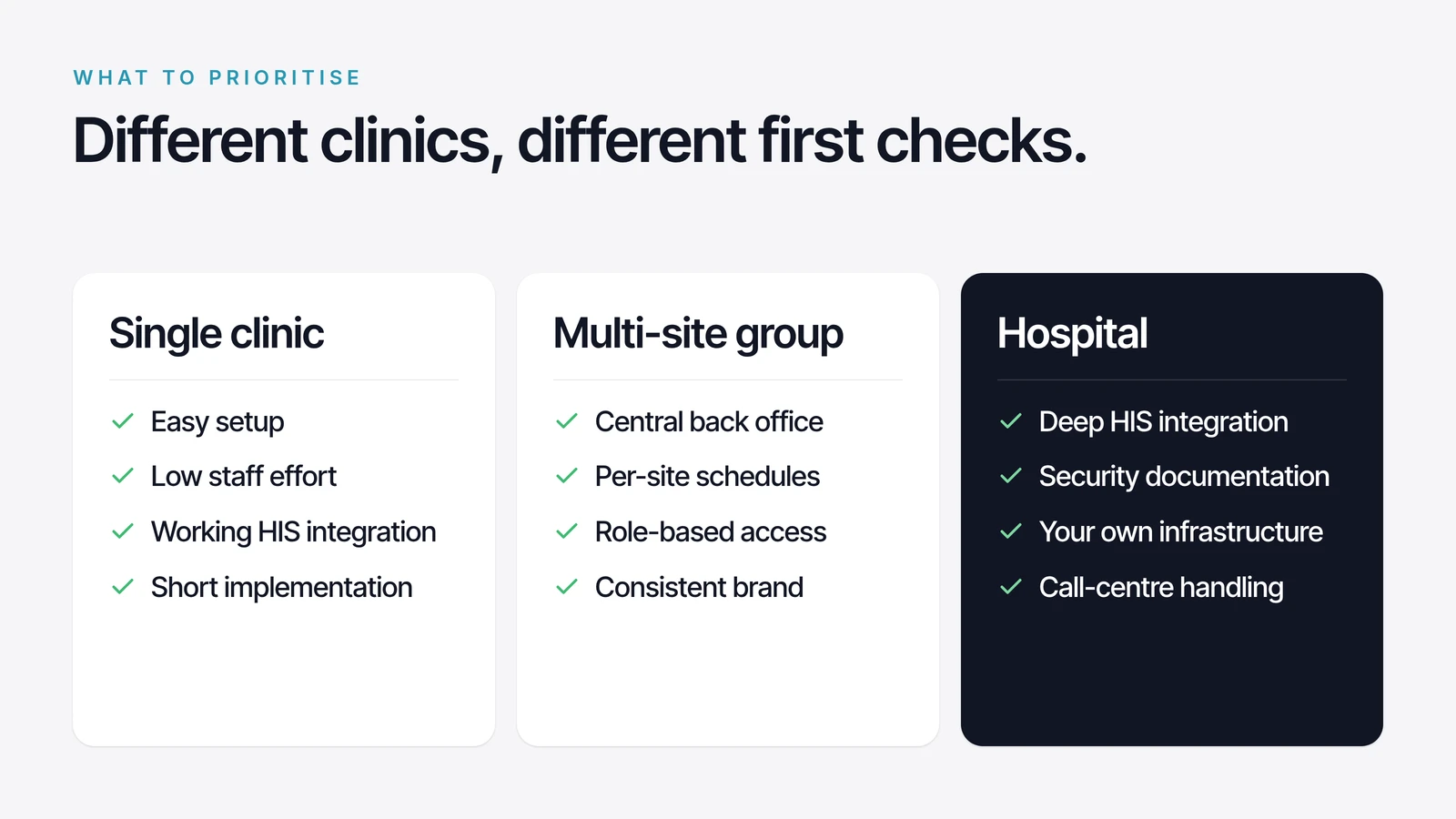
- Single clinic: easy setup, low staff effort and a working HIS integration. Avoid long implementations.
- Multi-site private group: a central back office, per-site schedules, role-based access and a consistent brand.
- Hospital: deep HIS integration, security documentation, deployment on your own infrastructure, and call-centre handling.
Check HIS sync, data hosting and ownership, and channel coverage. Everything else can be fixed later; those three cannot.
Where Holty fits
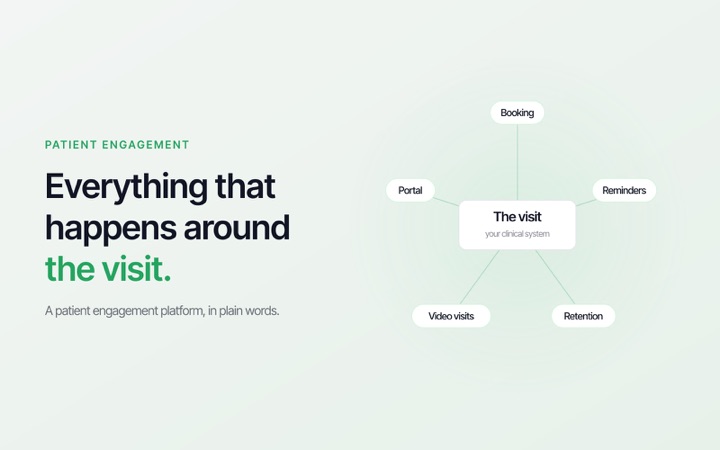
Holty is a PRM layer that sits on top of a clinic's HIS with two-way sync. It provides a branded patient app and messenger bots, telemedicine, AI Intake (which collects and structures information while the doctor decides), a Retention Engine that builds audiences from real visit history, and Call Intelligence for patient calls. It runs on the clinic's own servers or a managed EU cloud and is licensed, with 0% commission. It is built for clinics that want to own their patient relationship. It is not a marketplace and does not supply new patients from a directory.
The best PRM is the one your staff keep using and your patients can actually reach.
Test Holty against this checklist
Book a 15-minute demo and we'll go through all seven criteria on your own setup.
Frequently asked questions
Which PRM is best for a private clinic?
The one that meets the criteria above on your own HIS and workflow. Test two or three systems against the same checklist rather than choosing on features alone.
Should a PRM replace my HIS?
No. A good PRM sits on top of the HIS and syncs with it in both directions. Replacing the HIS is a different, larger project.
Is a patient app enough?
Usually not. Some patients will not install an app, so add messenger, SMS or email and keep a phone path open.
How do I compare PRM vendors fairly?
Use the same checklist and the same demo task for each: a booked visit flowing both ways with your HIS, and a total cost quote for your own patient volume.
Sources
- Kelley JM, et al. PLOS ONE, 2014. doi:10.1371/journal.pone.0094207
- Robotham D, et al. Using digital notifications to improve attendance in clinic. BMJ Open, 2016.
- Meta-analysis of older adults' patient portal use, PubMed Central (PMC13308762).