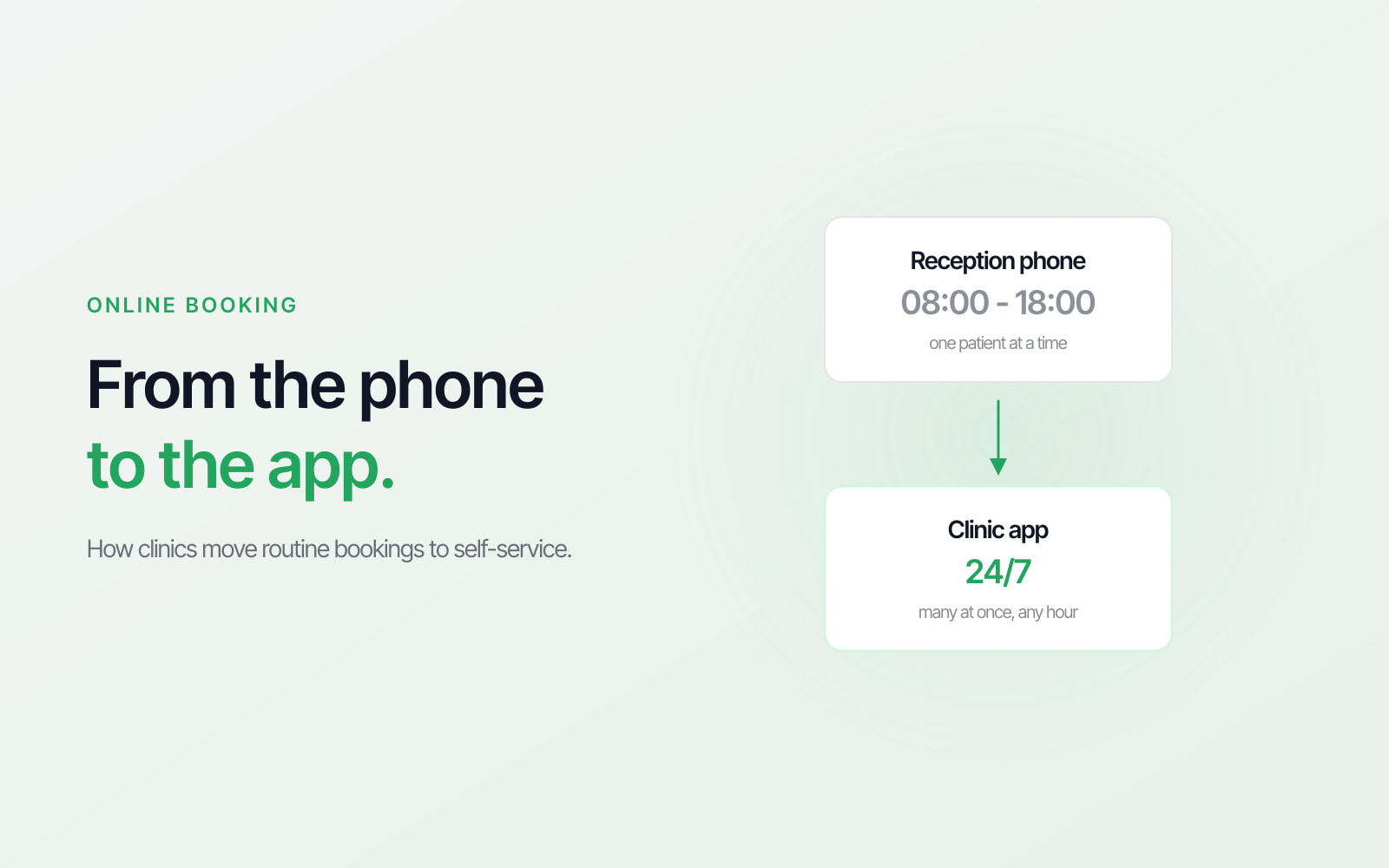
Every clinic that now takes bookings through an app once believed its patients would never stop calling. The pattern repeats so reliably it is almost a law: the owner is sure their patients are different - older, more traditional, attached to the phone. Then the switch happens, and within months a large share of appointments arrive silently, outside opening hours, without a single ring at reception.
This is a practical look at how that transition actually goes, and where it goes wrong.
Why the phone quietly costs so much
Phone booking feels free because it is already paid for. It is not. Every call is minutes of staff time; every busy signal is a patient who may try a competitor; every booking taken during a call is a patient standing at the desk being ignored. And the phone sleeps: a clinic reachable from 8 to 18 is unbookable exactly when working patients finally have time to think about their health.
The hidden cost shows up in the no-show line too. A booking made in a thirty-second call, with no confirmation and no reminder, is the easiest appointment in the world to forget.
What patients actually expect now
The habit is already formed, just not by healthcare. People book flights, tables and taxis from a screen, then call a clinic and reach a queue. Online doctor appointment booking is not an innovation to explain to patients anymore; it is an expectation your clinic either meets or fails.
The demand side is visible in the market: platforms built on a doctor appointment app model, Doctolib in France and Germany, Docplanner across Europe and beyond, grew into some of the continent's largest health companies on this behaviour shift alone. The convenience is proven. The open question for a clinic is who owns the patient relationship afterwards: the marketplace's brand, or yours.
The transition, step by step
1. Put your real schedule online
The foundation is clinic booking software that mirrors your actual calendar - every practitioner, every room, every service with its true duration. If the online slots are not the real slots, staff will distrust the system and patients will double-book. This is where a two-way sync with your existing clinic system stops being a technicality and becomes the whole game.
2. Open self-service gradually
Patient self-scheduling can start with the low-risk visits - check-ups, follow-ups, cleanings - while complex cases still route through the desk. Clinics that switch everything overnight generate chaos; clinics that never expand beyond "request a callback" get none of the benefit.
3. Let reminders do the remembering
The moment a booking is digital, confirmations and reminders become automatic. This is typically the first place the clinic feels the change in money rather than convenience: fewer empty chairs, no extra staff.
4. Keep the phone
The goal is not to unplug it. Some patients will always prefer to call, and they should reach a human faster than before, because the routine traffic has moved to the app.
Where it goes wrong
Three failure modes account for most bad transitions. The schedule online is not the real schedule, so trust collapses. The booking tool is a silo, so staff re-type every appointment into the medical scheduling software they already run - twice the work, half the goodwill. Or the clinic rents its patients to a marketplace, and discovers that the platform's logo, not the clinic's, is what patients remember.
The short version
Move the routine bookings to self-service, keep the schedule honest, let the reminders run, and make sure the app carries your name. That is the entire playbook.
Holty is the version of it you can deploy under your own brand, on your own infrastructure, with two-way sync to the system you already use, and no commission on bookings your reputation earned.
See your own schedule running in it
Fifteen minutes, your calendar, your rules.