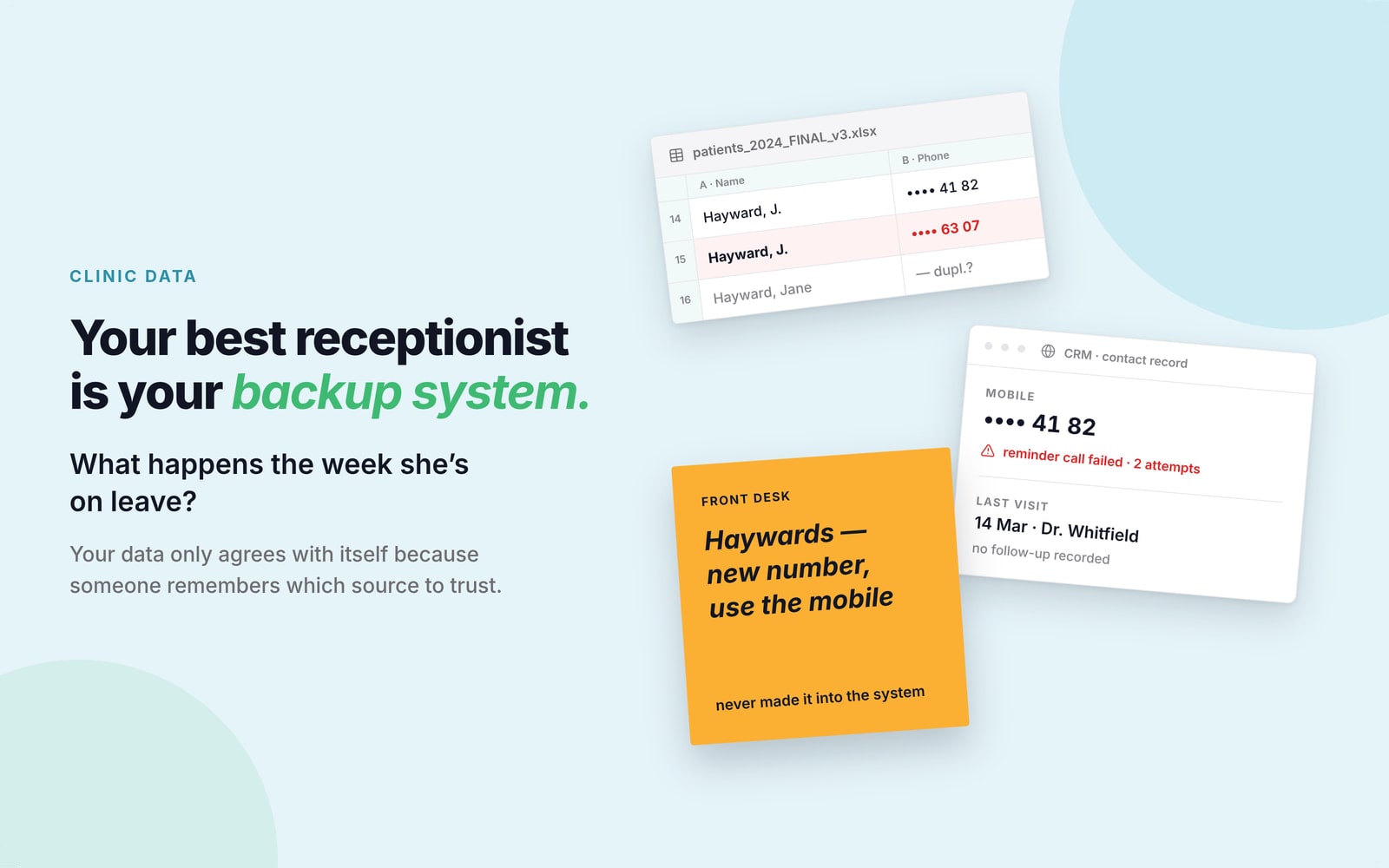
A patient calls to reschedule. The front desk pulls up an Excel sheet with their contact details, checks a separate CRM for their visit history, and flips through a paper notepad to confirm what the doctor mentioned last time about a follow-up test. None of these three sources fully agrees with the others. This is not a broken clinic. This is how a lot of clinics run every day, and it mostly works, until it doesn't.
It works, right up until the moment it doesn't
Ask most clinic managers if their data setup is a problem, and the honest answer is usually no. Staff know the workarounds. Everyone has learned which spreadsheet is the real one, which CRM fields are outdated, and whose handwriting to trust on the sticky note. The system holds together because people compensate for it constantly, not because it was designed to hold together on its own.
That distinction matters. A process that only works because experienced staff quietly patch its gaps is not stable. It is dependent on those specific people staying, remembering, and never having an off day. The moment someone new joins the front desk, or someone experienced leaves, the patchwork is gone and the gaps are exposed all at once.
Where the seams actually show
The failures rarely look dramatic. A patient updates their phone number when booking online, but the CRM used for reminders still has the old one, so a reminder call goes nowhere and the appointment becomes a no-show that looks like the patient's fault. A doctor's note about a needed follow-up sits in a paper file that never makes it into the system used for recall campaigns, so the follow-up never gets scheduled. Two staff members book the same slot because the Excel sheet used for walk-ins was not updated in real time.
Individually, each of these looks like a one-off mistake. Looked at together, they are the predictable result of keeping the same information in three places that never automatically agree with each other.
Why "we're used to it" is not the same as "it's fine"
The strongest argument for leaving things as they are is also the easiest one to make: staff have adapted, so it isn't a problem. But adaptation is not the same as efficiency. A team that has learned to work around fragmented data is spending real time and attention on reconciliation work that a connected system would simply not require. That time doesn't show up as a cost anywhere, because it's absorbed quietly into everyone's daily routine instead of appearing as a line item.
The same is true of errors. A missed follow-up or a double-booked slot rarely gets logged as a systemic issue. It gets treated as an individual mistake, apologised for, and forgotten, which means the clinic never actually sees how often this happens or what it costs in lost visits and frustrated patients.
What this costs in organisation and budget, not just patience
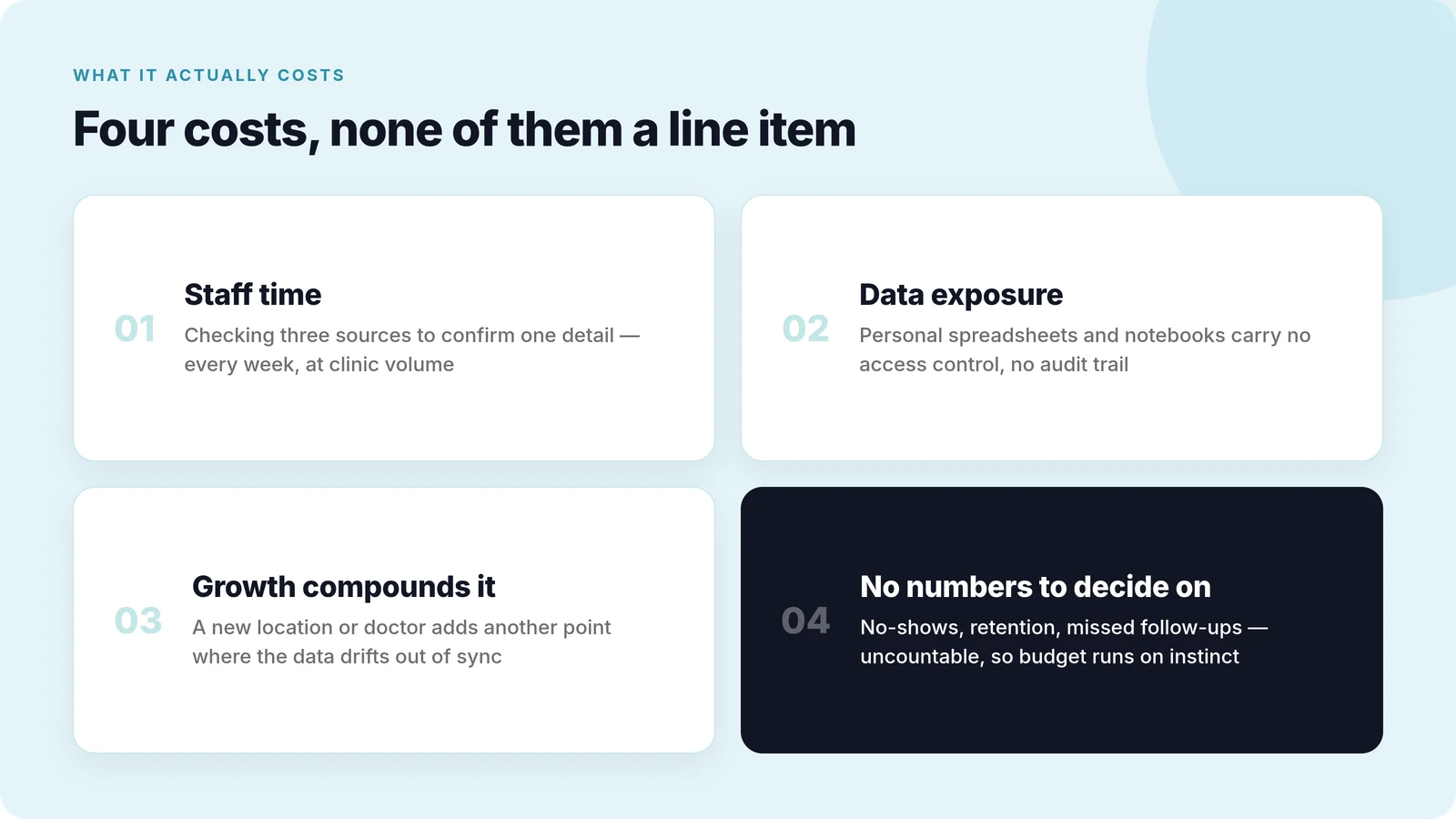
The clearest cost is staff time. Every minute spent checking three sources to confirm one patient's details is a minute not spent with a patient or moving the schedule forward, and at the volume of a working clinic, that adds up to real labour cost every single week.
The second cost is risk. Patient information sitting in a personal spreadsheet or a handwritten notebook usually has none of the access controls or audit trail that a proper record system would have. That is a genuine data protection exposure, not just an inconvenience, and it is the kind of gap that only becomes visible after something has already gone wrong.
The third cost is that growth makes everything worse, not better. Adding a second location, a new doctor, or simply more patients does not scale a spreadsheet-and-notebook system gracefully. Every new person is another point where information can drift out of sync, so the fragmentation problem grows faster than the clinic does.
The fourth cost is the hardest to see: a clinic running on three disconnected sources cannot easily report on itself. No-show rates, retention, missed follow-ups, none of it can be measured cleanly when the underlying data lives in incompatible places. That means budget and staffing decisions get made on instinct, because the numbers that should inform them were never actually collectible in the first place.
A single place to manage it all
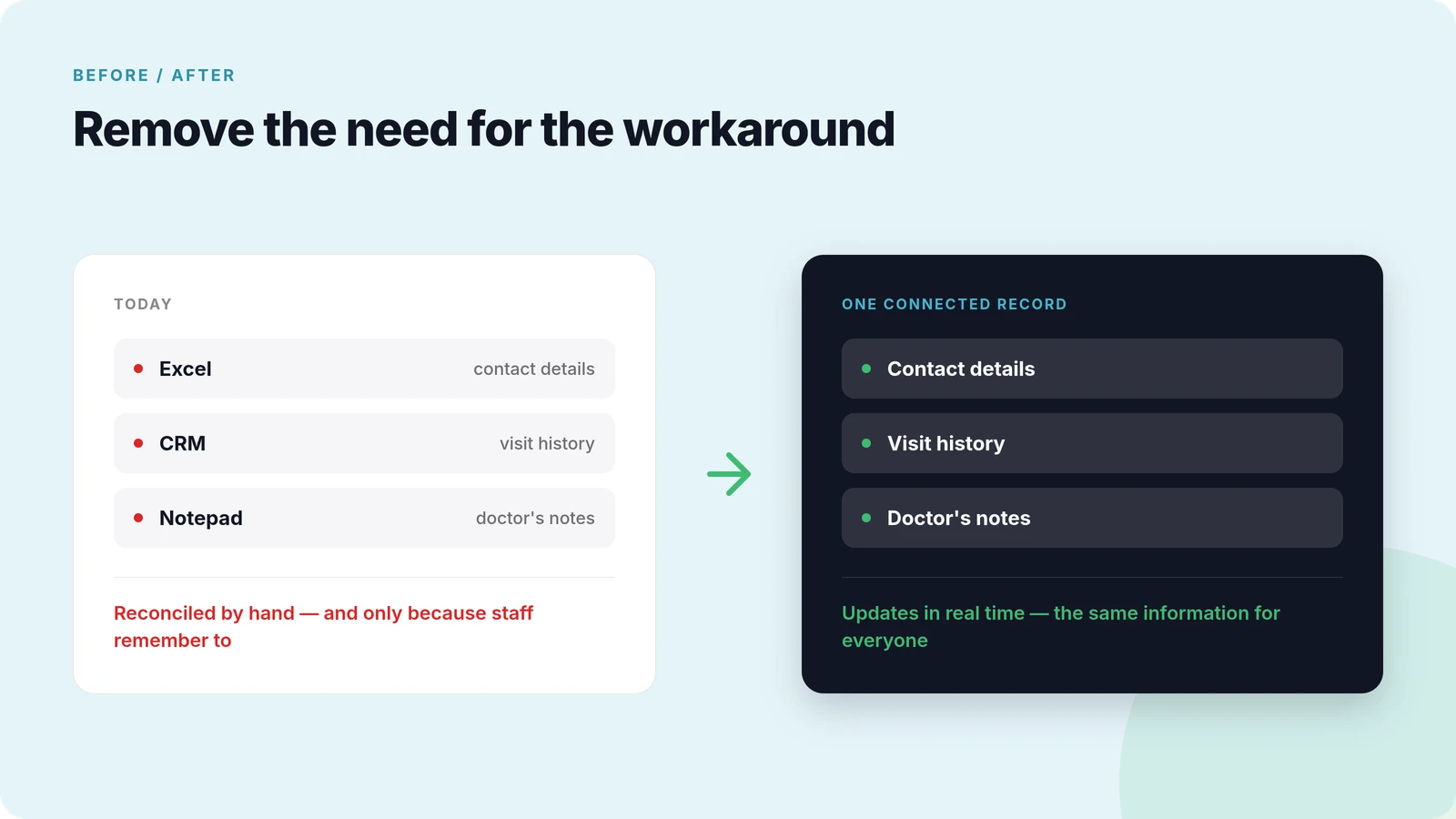
None of this requires blaming the staff who built the workarounds. They solved a real problem with the tools available. The actual fix is removing the need for the workaround in the first place: one system where a patient's contact details, visit history, and doctor's notes live together and update in real time, visible to whoever needs them, without anyone having to cross-check three sources to be sure.
That's the role Holty's back office plays underneath the patient-facing app: one place for patient records, doctor profiles, and document workflow, connected directly to how the clinic already runs, so the information front-desk staff rely on is the same information everyone else sees.
See what consolidating this looks like for your clinic
Book a 15-minute demo and we'll walk through your setup specifically.